You found the house. The seller says yes. No bank, no credit check, no six weeks of underwriting.
For thousands of Memphis families, that moment feels like the door finally opening. And it should. Dueño a dueño real estate — buying directly from an owner who finances the sale himself — has helped hardworking people in Frayser, Raleigh, Whitehaven, and Hickory Hill become homeowners when traditional lenders said no.
But here’s the truth nobody puts on a yard sign: the contract you sign matters more than the price you negotiate.
We’ve seen buyers in Memphis hand over $15,000 down and three years of payments, only to learn the deed was never going to be theirs. We’ve seen sellers get burned too. Almost every one of those disasters was preventable — because the warning signs were sitting right there in the paperwork.
Below are the five red flags we tell every buyer to look for before signing an owner-financed contract in Shelby County.
Why Owner Financing Is Growing Fast in Memphis Right Now
Memphis has one of the most affordable housing markets among major U.S. metros, and that affordability is exactly why seller financing keeps expanding here in 2026.
Three local forces are driving it:
- Bank standards haven’t loosened. Self-employed buyers, cash-paid workers, and families with thin credit files still get denied — even when they can clearly afford a $900 monthly payment.
- Older housing stock scares lenders. Much of Memphis’s inventory in neighborhoods like Berclair, Nutbush, and Orange Mound was built before 1970. Conventional and FHA appraisals routinely flag roofs, foundations, and electrical panels. Sellers finance because the bank won’t.
- Sellers want steady income. In a market with fluctuating rates, a landlord in Parkway Village or Hickory Hill would often prefer to collect a note payment rather than manage another rental.
That’s the good news. The risk is that Tennessee gives sellers a lot of freedom in how they structure these deals — and freedom cuts both ways.
Red Flag #1: The Deed Isn’t Clearly Addressed
What it looks like: The contract says you’ll “receive the deed when the balance is paid,” with no explanation of who holds title in the meantime — or the document never uses the word deed at all.
This is the single most damaging red flag in dueño-a-dueño transactions.
There are two very different structures out there:
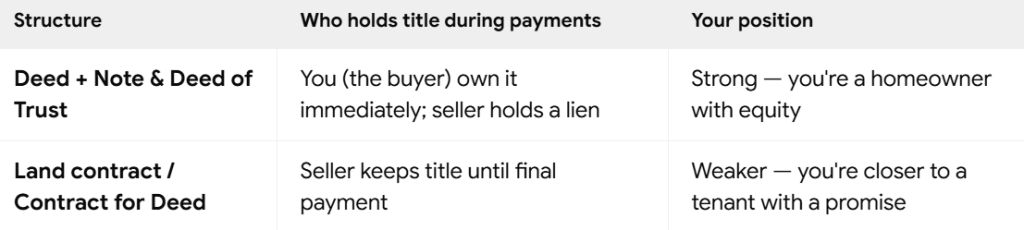
Neither is automatically illegal. But you need to know which one you’re signing, and land contracts require far more caution.
Protect yourself: Ask directly — “Am I getting the deed at closing?” If the answer is no, insist the contract be recorded with the Shelby County Register of Deeds so your interest is on public record. An unrecorded contract is nearly invisible if the seller later sells, refinances, or dies.
Red Flag #2: A Balloon Payment Buried in the Fine Print
What it looks like: “Payments of $875 monthly for 60 months, remaining balance due at maturity.”
Read that again. That last clause means after five years of on-time payments, you owe the entire remaining balance — often $80,000 or more — in one lump sum.
Balloon payments aren’t a scam by themselves. Most owner-financed deals in Memphis use them, because few sellers want to wait 30 years. The red flag is when nobody explains it, or when the term is unrealistically short.
What to look for:
- A balloon due in less than 3 years is aggressive. You may not have enough payment history or repaired credit to refinance in time.
- No written payoff schedule showing your balance each year.
- A seller who says “don’t worry, we’ll just renew it” — but won’t put renewal terms in writing.
Protect yourself: Negotiate for at least a 5-year balloon and a written extension option. Then start working on refinance eligibility from month one.
Red Flag #3: Property Taxes and Insurance Are Left Vague
Shelby County has some of the higher effective property tax rates in Tennessee, and inside Memphis city limits you’re paying both city and county taxes. On a modest $130,000 home, that’s a real number — and insurance costs have climbed sharply across the Mid-South after recent storm seasons.
What it looks like: The contract lists a monthly payment but never says who pays taxes and insurance, or says the seller “will handle it” with no escrow account.
Here’s the danger: if the seller is supposed to pay the taxes and quietly stops, the property can end up in a Shelby County tax sale — while you’re still making payments on time. Same story with insurance. If the house burns and there’s no valid policy, the loss can land on you.
Protect yourself:
- Require the contract to state exactly who pays taxes and insurance.
- Ask for proof of payment every year (a receipt, a declarations page).
- Verify current tax status yourself through the Shelby County Trustee before you sign.
- Get your own policy listing you as an insured party whenever the structure allows it.
Red Flag #4: A Harsh Forfeiture Clause
What it looks like: “If Buyer fails to make any payment within 10 days, this agreement terminates, Buyer forfeits all payments made and all improvements, and shall vacate immediately.”
This clause is why families lose everything over one bad month.
Under a strict forfeiture provision on a land contract, a single late payment can theoretically wipe out your down payment, every installment you’ve made, and the new roof you paid for. Tennessee courts don’t always enforce these clauses that harshly — especially when a buyer has substantial equity — but you do not want to be fighting that battle in Chancery Court with your family’s savings on the line.
Protect yourself: Negotiate for a cure period of at least 30 days, written notice of default sent by certified mail, and — ideally — language that requires a formal foreclosure process rather than instant forfeiture. A seller who refuses any cure period at all is telling you something about their intentions.
Red Flag #5: The Seller Still Has a Mortgage — and Won’t Talk About It
What it looks like: You ask, “Is there a loan on this property?” and get a vague answer, a subject change, or “that’s already handled.”
Many Memphis owner-financed homes are sold with an existing mortgage still in place (a “wrap”). That isn’t automatically a deal-killer, but it introduces serious exposure:
- Nearly every mortgage has a due-on-sale clause, letting the lender demand full payoff when the property transfers.
- If the seller collects your payment and doesn’t pay their lender, the bank can foreclose — and you can lose a home you never missed a payment on.
Protect yourself: Run a title search. Always. It costs a fraction of what you’re investing and reveals mortgages, liens, unpaid contractor claims, code enforcement judgments, and heirship problems — the last one being extremely common with inherited Memphis properties.
If there’s an underlying loan, ask for a third-party servicing arrangement so your payment goes to a neutral company that pays the lender first. That single step eliminates most wrap-around horror stories.
Bonus Warning Signs Worth a Second Look
- “We don’t need a title company.” You do. Always close through a title company or real estate attorney.
- Cash-only, no receipts. Pay by check, transfer, or servicer. Create a paper trail.
- Pressure to sign today. Legitimate sellers give you time to review.
- Verbal promises only. “I’ll fix the HVAC after closing” means nothing unless it’s in the contract.
- The seller isn’t on the deed. Confirm the person signing actually owns the property.