Finding a spacious home with flexible financing in the Bartlett area isn’t always easy, but 3771 Old Brownsville Rd delivers on all fronts. Whether you’re looking for room to grow, a solid long-term investment, or a path to homeownership that bypasses traditional bank hurdles, this property is a rare find.
Property Details at a Glance
Address: 3771 Old Brownsville Rd, Bartlett, TN 38135
Bedrooms: 3
Bathrooms: 2
Square Footage: 2,953 sq. ft.
Year Built: 1963
Down Payment: $15,000.00
Financing: Owner-to-Owner Financing Available
Generous Space with Classic Mid-Century Character
Built in 1963, this home offers the solid structural layout and generous room sizes typical of mid-century construction. Spanning nearly 3,000 square feet, the property gives you incredible flexibility:
Spacious Living Areas: Plenty of square footage to create a open-concept main floor, formal dining setup, or dedicated family room.
3 Comfortable Bedrooms & 2 Full Baths: Generous room sizes with substantial closet space.
Flexible Square Footage: Extra space can easily host a home office, recreation room, workshop, or hobby area.
Why Bartlett, TN (38135)?
Located in Shelby County, the 38135 area of Bartlett is known for its strong community feel, convenient amenities, and easy commute options throughout Greater Memphis.
Convenience: Quick access to major routes, shopping centers, dining, and local parks.
Established Neighborhood: Enjoy tree-lined streets and a settled community atmosphere.
Value: Bartlett remains one of the most sought-after suburban areas in the region.
The Big Advantage: Owner-to-Owner Financing
Skip the hassle of conventional mortgage applications, stringent credit checks, and long closing delays.
With Owner-to-Owner Financing and an accessible $15,000 down payment, your route to homeownership is direct and straightforward:
Simpler Process: Deal directly with the owner without third-party lender friction.
Faster Closing: Move in faster without waiting weeks for bank underwriting.
Accessible Ownership: A practical option if you’re self-employed, building credit, or prefer direct seller terms.
Owner financing means the person selling the house lends you the money to buy it. Instead of going to a bank for a mortgage, you make monthly payments directly to the seller. You still own the home — the title can be in your name from day one — but the seller holds the financial note instead of a bank. It’s a legitimate, legal way to buy a home in Tennessee. For buyers who don’t qualify for traditional loans, it’s often the only path to homeownership.
What Owner Financing Is — and How It’s Different from a Bank Loan
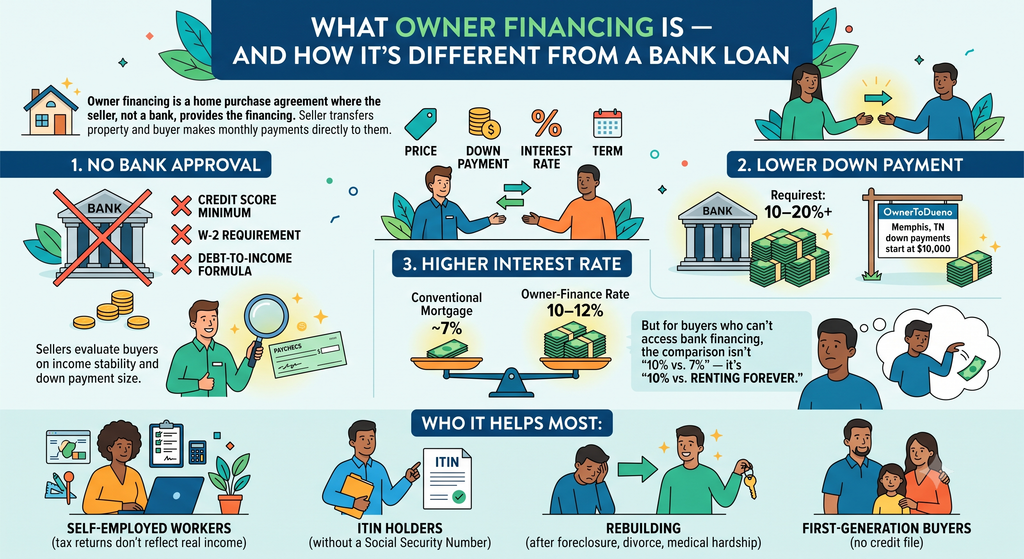
Owner financing is a home purchase agreement where the seller, not a bank, provides the financing. The seller and buyer agree on a price, down payment, interest rate, and term. The seller transfers the property, and the buyer makes monthly payments directly to them.
The main differences from a bank loan:
No bank approval. No credit score minimum, no W-2 requirement, no debt-to-income formula. Sellers evaluate buyers on income stability and down payment size.
Lower down payment. Banks require 10–20%+. On OwnerToDueno listings in Memphis, down payments start at $10,000.
Higher interest rate. Owner-finance rates in Memphis run 10–12% — higher than a conventional mortgage. But for buyers who can’t access bank financing at any rate, the comparison isn’t “10% vs. 7%” — it’s “10% vs. renting forever.”
Who it helps most: Self-employed workers whose tax returns don’t reflect real income. ITIN holders without a Social Security Number. Buyers rebuilding after foreclosure, divorce, or medical hardship. First-generation buyers with no credit file.
How the Process Works: Step by Step
Step 1 — Find a property. Browse ownertodueno.com. Every listing shows the asking price, down payment, estimated monthly payment, and property details. Current inventory runs from $159,000 in North Memphis (38128) to $289,000 in Cordova (38018). Step 2 — Contact the team. A team member walks you through the exact terms: down payment, interest rate, 30-year term, and estimated monthly payment. Step 3 — Submit your application. Not a credit check — a verification of income and available down payment. Bank statements or pay stubs work. Response in 24–48 hours. Step 4 — Agree on terms in writing. Purchase price, down payment, fixed interest rate (10–12%), 30-year term, monthly payment amount, and the default process. Read this section carefully. Step 5 — Close at a licensed title company. Every OwnerToDueno transaction closes through Bradsher, Albert & Stuart, PLLC — a licensed Tennessee attorney firm and title company in Memphis. They conduct the title search, hold your down payment in escrow, record the deed of trust with Shelby County, and give both parties every signed document. Step 6 — Make monthly payments and build equity. After closing, you’re the homeowner — you maintain the property, pay taxes and insurance, and make improvements. After 30 years, the note is paid off and the property is fully yours.
Common Risks and Misunderstandings
“The seller can take my house back whenever they want.”
Not with a properly recorded deed of trust. The seller must go through Tennessee’s formal foreclosure process — months of legal procedure, required notices. The protection is the recording. If anyone asks you to sign without a title company, walk away.
“Owner financing is a scam.”
It can be — when done informally, without a recorded contract. The protection is always the same: close through a licensed title company, get a recorded contract, keep your paperwork.
“I’ll definitely own the title from day one.”
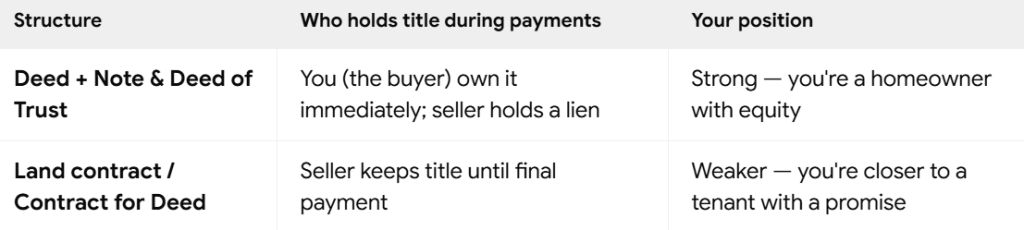
Depends on the contract. With a warranty deed: title transfers to you at closing, seller holds a lien. With a contract for deed (land contract): seller retains title until a specified amount is paid. Both are legal in Tennessee — know which one you’re signing.
“The rate is too high.”
10–12% is higher than a bank rate. But if you’re currently paying $1,500/month in rent and building zero equity, a $1,600/month owner-finance payment that builds ownership is a different financial picture entirely.
“Missing a payment won’t matter.”
It works exactly like a bank mortgage. After a grace period you go into default. Private lenders have more flexibility than banks — but only if you communicate early.
Frequently Asked Questions
Do I need a Social Security Number to use owner financing in Memphis?
No. An ITIN is sufficient to sign contracts and take title to property in Tennessee. Many OwnerToDueno buyers are ITIN holders who pay taxes, have stable income, and have been renting for years. Owner financing is the path that works for them.
What down payment do I need?
Down payments on OwnerToDueno listings start at $10,000. Properties in the $200,000–$289,000 range typically require $15,000–$20,000. The exact amount is on each property listing page.
Who holds the title during the financing period?
In most OwnerToDueno transactions, the title transfers to the buyer at closing via a warranty deed. The seller holds a lien — a deed of trust — not the title itself. Your name is on the property from day one.
What if I want to sell before the note is paid off?
Most owner-finance contracts include a due-on-sale clause. When you sell, the proceeds pay off the remaining balance to the seller. You keep whatever equity is above that — same as paying off a bank mortgage at sale.
Can sellers list owner-financed properties on OwnerToDueno?
Yes. OwnerToDueno connects sellers who want to carry financing with qualified buyers. Every transaction still closes through a licensed title company, protecting both sides.
Ready to Buy or List?
Browse current owner-financed homes at ownertodueno.com — Cordova, Bartlett, South Memphis, Midtown, and across the Memphis metro, down payments starting at $10,000.
You found the house. The seller says yes. No bank, no credit check, no six weeks of underwriting.
For thousands of Memphis families, that moment feels like the door finally opening. And it should. Dueño a dueño real estate — buying directly from an owner who finances the sale himself — has helped hardworking people in Frayser, Raleigh, Whitehaven, and Hickory Hill become homeowners when traditional lenders said no.
But here’s the truth nobody puts on a yard sign: the contract you sign matters more than the price you negotiate.
We’ve seen buyers in Memphis hand over $15,000 down and three years of payments, only to learn the deed was never going to be theirs. We’ve seen sellers get burned too. Almost every one of those disasters was preventable — because the warning signs were sitting right there in the paperwork.
Below are the five red flags we tell every buyer to look for before signing an owner-financed contract in Shelby County.
Why Owner Financing Is Growing Fast in Memphis Right Now
Memphis has one of the most affordable housing markets among major U.S. metros, and that affordability is exactly why seller financing keeps expanding here in 2026.
Three local forces are driving it:
Bank standards haven’t loosened. Self-employed buyers, cash-paid workers, and families with thin credit files still get denied — even when they can clearly afford a $900 monthly payment.
Older housing stock scares lenders. Much of Memphis’s inventory in neighborhoods like Berclair, Nutbush, and Orange Mound was built before 1970. Conventional and FHA appraisals routinely flag roofs, foundations, and electrical panels. Sellers finance because the bank won’t.
Sellers want steady income. In a market with fluctuating rates, a landlord in Parkway Village or Hickory Hill would often prefer to collect a note payment rather than manage another rental.
That’s the good news. The risk is that Tennessee gives sellers a lot of freedom in how they structure these deals — and freedom cuts both ways.
Red Flag #1: The Deed Isn’t Clearly Addressed
What it looks like: The contract says you’ll “receive the deed when the balance is paid,” with no explanation of who holds title in the meantime — or the document never uses the word deed at all.
This is the single most damaging red flag in dueño-a-dueño transactions.
There are two very different structures out there:
Neither is automatically illegal. But you need to know which one you’re signing, and land contracts require far more caution.
Protect yourself: Ask directly — “Am I getting the deed at closing?” If the answer is no, insist the contract be recorded with the Shelby County Register of Deeds so your interest is on public record. An unrecorded contract is nearly invisible if the seller later sells, refinances, or dies.
Red Flag #2: A Balloon Payment Buried in the Fine Print
What it looks like: “Payments of $875 monthly for 60 months, remaining balance due at maturity.”
Read that again. That last clause means after five years of on-time payments, you owe the entire remaining balance — often $80,000 or more — in one lump sum.
Balloon payments aren’t a scam by themselves. Most owner-financed deals in Memphis use them, because few sellers want to wait 30 years. The red flag is when nobody explains it, or when the term is unrealistically short.
What to look for:
A balloon due in less than 3 years is aggressive. You may not have enough payment history or repaired credit to refinance in time.
No written payoff schedule showing your balance each year.
A seller who says “don’t worry, we’ll just renew it” — but won’t put renewal terms in writing.
Protect yourself: Negotiate for at least a 5-year balloon and a written extension option. Then start working on refinance eligibility from month one.
Red Flag #3: Property Taxes and Insurance Are Left Vague
Shelby County has some of the higher effective property tax rates in Tennessee, and inside Memphis city limits you’re paying both city and county taxes. On a modest $130,000 home, that’s a real number — and insurance costs have climbed sharply across the Mid-South after recent storm seasons.
What it looks like: The contract lists a monthly payment but never says who pays taxes and insurance, or says the seller “will handle it” with no escrow account.
Here’s the danger: if the seller is supposed to pay the taxes and quietly stops, the property can end up in a Shelby County tax sale — while you’re still making payments on time. Same story with insurance. If the house burns and there’s no valid policy, the loss can land on you.
Protect yourself:
Require the contract to state exactly who pays taxes and insurance.
Ask for proof of payment every year (a receipt, a declarations page).
Verify current tax status yourself through the Shelby County Trustee before you sign.
Get your own policy listing you as an insured party whenever the structure allows it.
Red Flag #4: A Harsh Forfeiture Clause
What it looks like: “If Buyer fails to make any payment within 10 days, this agreement terminates, Buyer forfeits all payments made and all improvements, and shall vacate immediately.”
This clause is why families lose everything over one bad month.
Under a strict forfeiture provision on a land contract, a single late payment can theoretically wipe out your down payment, every installment you’ve made, and the new roof you paid for. Tennessee courts don’t always enforce these clauses that harshly — especially when a buyer has substantial equity — but you do not want to be fighting that battle in Chancery Court with your family’s savings on the line.
Protect yourself: Negotiate for a cure period of at least 30 days, written notice of default sent by certified mail, and — ideally — language that requires a formal foreclosure process rather than instant forfeiture. A seller who refuses any cure period at all is telling you something about their intentions.
Red Flag #5: The Seller Still Has a Mortgage — and Won’t Talk About It
What it looks like: You ask, “Is there a loan on this property?” and get a vague answer, a subject change, or “that’s already handled.”
Many Memphis owner-financed homes are sold with an existing mortgage still in place (a “wrap”). That isn’t automatically a deal-killer, but it introduces serious exposure:
Nearly every mortgage has a due-on-sale clause, letting the lender demand full payoff when the property transfers.
If the seller collects your payment and doesn’t pay their lender, the bank can foreclose — and you can lose a home you never missed a payment on.
Protect yourself: Run a title search. Always. It costs a fraction of what you’re investing and reveals mortgages, liens, unpaid contractor claims, code enforcement judgments, and heirship problems — the last one being extremely common with inherited Memphis properties.
If there’s an underlying loan, ask for a third-party servicing arrangement so your payment goes to a neutral company that pays the lender first. That single step eliminates most wrap-around horror stories.
Bonus Warning Signs Worth a Second Look
“We don’t need a title company.” You do. Always close through a title company or real estate attorney.
Cash-only, no receipts. Pay by check, transfer, or servicer. Create a paper trail.
Pressure to sign today. Legitimate sellers give you time to review.
Verbal promises only. “I’ll fix the HVAC after closing” means nothing unless it’s in the contract.
The seller isn’t on the deed. Confirm the person signing actually owns the property.
Ask any real estate investor working the Memphis market—from Frayser and Orange Mound over to Cordova and Hickory Hill—and they will tell you the same thing: buying local rental property is the easy part. The real challenge starts after the closing papers are signed.
You probably bought your Shelby County rentals for the exact reasons everyone else does—predictable cash flow, affordable entry prices, and a massive pool of long-term renters.
But if you’ve been managing these properties for more than a few years, you’ve likely realized that “passive income” rarely feels passive. Between tracking down late rent checks, managing rising property insurance premiums in Tennessee, dealing with the latest broken HVAC unit, and watching property management fees eat up 10% of your gross margins, landlording can quickly turn into a stressful second job.
Fortunately, there is a better way to capture the high yields of the Memphis market without ever dealing with a single maintenance emergency or eviction court date. Sophisticated local investors are quietly shifting away from traditional renting and moving into the Dueño a Dueño (DAD) model.
By structuring compliant owner financing, you stop playing the role of the stressed landlord and step into the most profitable position on the balance sheet: you become the bank.
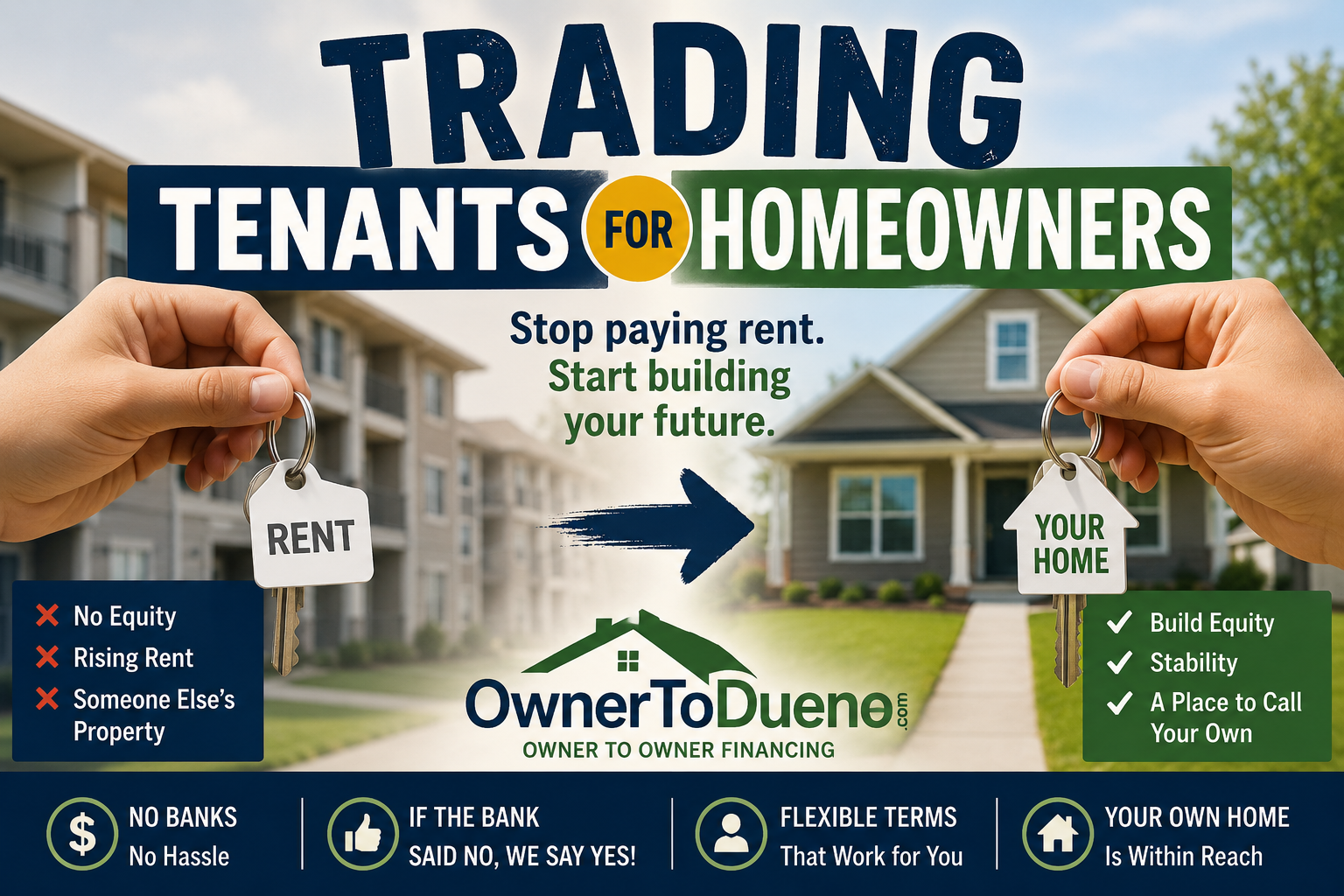
The Operational Shift: Trading Tenants for Homeowners
When you sell a property using the DAD owner-financing framework, your entire relationship with the resident changes. You aren’t signing a standard 12-month lease with a tenant; you are signing a legal promissory note and a deed of trust with a homebuyer.
Because they now legally own the home, the operational liabilities that used to drain your bank account completely vanish:
Zero Maintenance or CapEx Expense: If a water heater bursts in a rental property at 2:00 AM, you pay for it. Under the DAD model, that property belongs to the buyer. All maintenance, structural repairs, and roofing upgrades are entirely their responsibility.
No Property Management Costs: Since there are no tenants to manage or maintenance tickets to dispatch, you don’t need a middleman. You instantly save the 8% to 10% monthly cut typically charged by local property management firms.
An End to the Turnover Cycle: The average Memphis renter moves out every 12 to 24 months. Every time they leave, you lose a month of rent and spend thousands on paint, flooring, and repairs just to make the property presentable again. DAD buyers are making a long-term commitment to a home they intend to keep for decades.
Understanding the Numbers: The Memphis DAD Deal Breakdown
How does a note portfolio deliver 10% to 12% fixed yields while regular rental yields continue to shrink? It comes down to premium interest rates and strong, upfront cash down payments.
Many hardworking Memphis families—such as self-employed contracting business owners, local landscaping operators, and stable ITIN holders—are completely locked out of traditional bank mortgages due to rigid, automated algorithmic lending requirements. However, they possess excellent household incomes and substantial cash reserves. Because they are locked out of traditional banks, they gladly pay a premium interest rate for alternative financing.
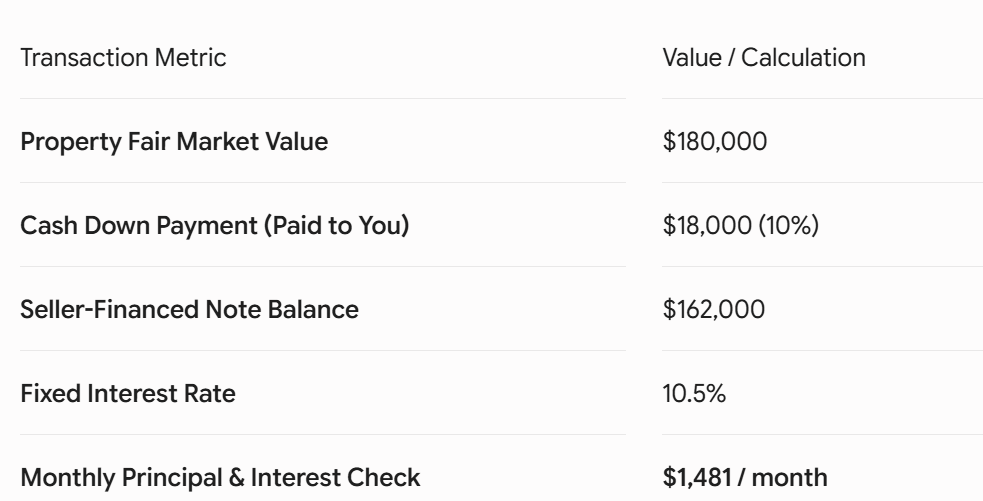
Let’s look at how a typical property transaction stacks up in Shelby County:
If you kept that exact same $180,000 house as a standard rental, it might pull in $1,450 a month in gross rent. But look closely at what happens to that money before it reaches your pocket:
Minus property management fees ($145)
Minus a standard monthly maintenance/CapEx reserve ($150)
Minus vacancy buffers ($75)
Actual Net Cash Flow: Drops to around $1,080
With the DAD note model, your $1,481 check is 100% net profit. The buyer is legally responsible for paying the annual property taxes to the Shelby County Trustee and maintaining homeowners insurance. Your monthly check arrives clean, untouched by unexpected operational bills.
Vetting Buyers: Equity is Your Security Blanket
A common question among local real estate circles is: “If a buyer can’t get a traditional bank loan from a commercial lender, aren’t they too high of a credit risk?”
In a traditional mortgage environment, an automated computer program rejects anyone without a standard W-2 or a perfect FICO score. This leaves out thousands of reliable, cash-flowing families right here in Memphis.
The DAD model relies on a much safer metric: massive upfront skin in the game.
By requiring non-refundable down payments of $10,000 to $20,000 (or more), these families are putting down substantial equity on day one. They do not view themselves as renters who can easily walk away from a security deposit; they view themselves as homeowners who have invested their life savings into an asset. They take pride in the home, maintain it meticulously, and treat their monthly note payment as their absolute highest financial priority.
Tax Advantages: Defer Capital Gains Taxes
If you sell your appreciated Memphis rental properties the traditional way on the MLS, you face a major financial hurdle: the capital gains tax. Selling a property outright triggers an immediate, hefty tax bill from the IRS on all your accumulated depreciation and equity gains.
Defer Taxes Using an Installment Sale
By transitioning your properties into a DAD note portfolio, you can structure the exit as an Installment Sale. Instead of paying taxes on your entire gain in year one, you spread the tax liability over the lifetime of the note under IRS Form 6252. You only pay taxes on the small portion of principal you receive each year, keeping the rest of your money actively compounding at that lucrative 10% to 12% interest rate.
Step Back from Day-to-Day Management
You don’t have to liquidate your entire real estate portfolio and leave the Memphis market just to escape the stress of landlording. You simply need to reposition where you sit on the transaction. Moving your investments from volatile rental units into predictable, fixed-rate note portfolios lets you secure stable, double-digit cash flow without the operational headaches.
At Owner to Dueño, we take care of the entire lifecycle of this transition. We handle local compliance, market your property to cash-ready buyers within the bilingual community, and help you structure secure, legally binding owner-financed notes right here in Shelby County.
Ready to upgrade your cash flow?
Let’s look at your current inventory. Connect with Owner to Dueño Today to discover how easily you can convert your active tenant headaches into entirely passive monthly interest checks.
Finding a great home in the Memphis area isn’t the hard part. Whether you are looking at a quiet, established neighborhood in Bartlett, a spacious 4-bedroom family home in Cordova, or a classic property closer to the heart of Memphis, the houses are out there.
The real challenge? Dealing with the banks.
For local business owners, self-employed contractors, or anyone working hard to rebuild their credit score, traditional mortgage lenders can make homeownership feel completely out of reach. The endless paperwork, rigid underwriters, and strict automated systems often say “no” before they even look at your actual financial capability.
But you don’t need a traditional bank loan to buy a house in Shelby County. Local buyers and sellers are discovering a faster, fairer alternative: owner financing, or direct dueño a dueño transactions.
What is Owner Financing? It’s simple. Instead of getting a massive loan from a bank to pay the seller, you buy the home directly from the property owner. You agree on a down payment and monthly terms together, and you pay the owner directly. The bank is cut out of the loop entirely.
Why Local Buyers are Skipping the Bank in Memphis, Cordova, and Bartlett
1. True Credit Flexibility
Memphis is a city built on hard work and entrepreneurship. If you run your own business, work in logistics, or operate a local service, your tax returns might not fit into a bank’s neat little boxes. With owner-to-owner financing, sellers look at your actual ability to pay today, your job stability, and your commitment to the home—not just a single three-digit credit score.
2. Fast Closing Without the Red Tape
A traditional bank mortgage takes anywhere from 45 to 60 days to close, keeping your life in limbo while corporate underwriters shuffle papers. A direct owner-financed transaction can close in a fraction of that time because you are dealing with a human being, not an institution.
3. Stop Paying Landlords, Start Building Equity
Rent across Cordova and Bartlett keeps climbing, but that monthly check only builds wealth for your landlord. When you buy a home through seller financing, your monthly payments go toward an asset you own. You get the stability of homeownership and the freedom to truly make the house your own.
Making Homeownership Accessible to Everyone
Language and cultural barriers shouldn’t keep you from owning a piece of your community. One of the biggest advantages of working with Owner to Dueño is our commitment to clear, transparent, and completely bilingual real estate.
Buying a home is one of the biggest financial decisions you will ever make. You deserve to understand every step of the process, every line of the contract, and every detail of your payment schedule—whether you prefer to do business in English or Spanish.
Find Your Direct-Sale Home in Shelby County
The path from renting to owning doesn’t have to go through a corporate bank tower. If you are looking for a straightforward, human-to-human way to purchase your next property, owner financing opens doors that traditional lenders close.
At Owner to Dueño, we specialize in connecting local buyers and sellers directly, bringing transparent owner-financed options straight to the Memphis market.
Ready to stop renting? Check out our latest direct-sale listings across Memphis, Cordova, and Bartlett, and take control of your financial future today.
¿Listo para dar el paso de inquilino a propietario? En Owner to Dueño entendemos que el proceso de compra puede ser complicado, por eso te ayudamos en tu propio idioma. Compra tu casa de dueño a dueño, sin intermediarios bancarios y con total transparencia. ¡Explora nuestras propiedades disponibles hoy mismo!
Encontrar una buena casa en el área de Memphis no es la parte difícil. Ya sea que estés buscando en un vecindario tranquilo y establecido en Bartlett, una espaciosa casa familiar de 4 habitaciones en Cordova, o una propiedad clásica más cerca del corazón de Memphis, las opciones están ahí afuera.
El verdadero desafío es lidiar con los bancos.
Para los dueños de negocios locales, contratistas independientes o cualquier persona que esté trabajando duro para reconstruir su historial de crédito, los prestamistas hipotecarios tradicionales pueden hacer que el sueño de tener casa propia parezca completamente inalcanzable. El papeleo interminable, las exigencias de los analistas de crédito y los sistemas automatizados suelen decir “no” antes de evaluar tu verdadera capacidad financiera.
Pero no necesitas un préstamo bancario tradicional para comprar una casa en el condado de Shelby. Los compradores y vendedores locales están descubriendo una alternativa más rápida y justa: el financiamiento por el propietario, o transacciones directas dueño a dueño.
¿Qué es el Financiamiento por el Propietario? Es simple. En lugar de pedir un préstamo enorme a un banco para pagarle al vendedor, le compras la casa directamente al dueño de la propiedad. Acuerdan un pago inicial (down payment) y los términos mensuales entre ustedes, y le pagas directamente al dueño. El banco queda fuera del proceso por completo.
Por Qué los Compradores Locales Están Evitando los Bancos en Memphis, Cordova y Bartlett
1. Flexibilidad Real con el Crédito
Memphis es una ciudad construida sobre el trabajo duro y el emprendimiento. Si manejas tu propio negocio, trabajas en logística o tienes una empresa de servicios locales, es muy probable que tus declaraciones de impuestos no encajen en los moldes estrictos de un banco. Con el financiamiento de dueño a dueño, los vendedores se fijan en tu capacidad real de pago actual, tu estabilidad laboral y tu compromiso con la casa, no en un simple número de tres dígitos de tu puntaje de crédito.
2. Cierre Rápido y sin Trámites Burocráticos
Una hipoteca bancaria tradicional tarda entre 45 y 60 days en cerrarse, manteniendo tu vida en pausa mientras los analistas corporativos revisan papeles. Una transacción directa financiada por el propietario puede cerrarse en una fracción de ese tiempo porque estás tratando con un ser humano, no con una institución financiera.
3. Deja de Pagar Renta y Empieza a Construir tu Patrimonio
Los alquileres en Cordova y Bartlett siguen subiendo, pero ese cheque mensual solo genera riqueza para tu arrendador. Cuando compras una casa a través de financiamiento del vendedor, tus pagos mensuales se destinan a un activo que es tuyo. Obtienes la estabilidad de tener tu propia casa y la libertad de cambiarla y mejorarla como tú quieras.
Haciendo que la Compra de Vivienda Sea Accesible para Todos
Las barreras del idioma y la cultura no deberían impedir que seas dueño de una propiedad en tu comunidad. Una de las mayores ventajas de trabajar con Owner to Dueño es nuestro compromiso con un mercado inmobiliario claro, transparente y completamente bilingüe.
Comprar una casa es una de las decisiones financieras más importantes de tu vida. Mereces entender cada paso del proceso, cada línea del contrato y cada detalle de tu plan de pagos, ya sea que prefieras hacer negocios en inglés o en español.
Encuentra tu Casa de Venta Directa en el Condado de Shelby
El camino para dejar de rentar y convertirte en propietario no tiene por qué pasar por la oficina de un banco corporativo. Si estás buscando una forma directa y de humano a humano para comprar tu próxima propiedad, el financiamiento por el propietario abre las puertas que los prestamistas tradicionales cierran.
En Owner to Dueño, nos especializamos en conectar directamente a compradores y vendedores locales, trayendo opciones transparentes de financiamiento por el dueño al mercado de Memphis.
¿Listo para dejar de rentar? Revisa nuestras últimas propiedades de venta directa en Memphis, Cordova y Bartlett, y toma el control de tu futuro financiero hoy mismo.
Are you ready to transition from renter to homeowner? At Owner to Dueño, we understand that the buying process can feel overwhelming, which is why we guide you every step of the way in your preferred language. Buy your home owner-to-owner, with zero bank interference and total transparency. Explore our available properties today!
Let’s be completely honest for a second. The traditional home-buying process is broken for a lot of hard-working people.
You find a house you love, you calculate your budget, and you know you can afford the monthly payments. But then you walk into a traditional bank, and the door slams shut. Maybe a fluctuating credit score from a few years ago is holding you back. Maybe you are self-employed, and your tax returns don’t fit into the bank’s rigid little boxes. Or maybe the endless mountain of red tape just feels impossible to climb.
At Dueño A Dueño, we don’t believe a bank rejection should mean the end of your homeownership dream.
There is a faster, simpler, and much more human way to buy a home: Owner-to-Owner Financing (also known as seller financing). If you are tired of paying rent that builds someone else’s wealth, here is why bypassing the middleman might be the best financial move you ever make.
What Exactly is Owner-to-Owner Financing?
In a standard real estate transaction, a bank acts as the middleman. They give the seller the money, and you spend the next 15 to 30 years paying the bank back with heavy interest.
With Owner-to-Owner financing, you completely cut the bank out of the equation.
Instead of getting a mortgage from a financial institution, you buy the home directly from the current owner. You both agree on a purchase price, a down payment, and a monthly payment structure. You make your monthly payments directly to the seller (or a processing service) until the house is completely yours.
It’s a direct, transparent contract between two individuals. No corporate overhead, no hidden bank fees, and no waiting months for an underwriter to approve your life.
The Big Benefits: Why Memphis Buyers are Making the Switch
For many families in our community, direct financing isn’t just an alternative—it’s a much better experience. Here is why:
Credit Flexibility: Sellers are real people, not algorithms. They care much more about your current income, your job stability, and your commitment to making payments than a single three-digit credit score.
Bypassing the Self-Employed Trap: If you run your own business, contract, or work in the gig economy, banks make you jump through endless hoops to prove your income. Sellers look at your actual ability to pay, keeping the process moving forward.
Drastically Lower Closing Costs: Traditional mortgages come loaded with bank origination fees, processing fees, and administrative costs that add up to thousands of dollars. Eliminating the bank keeps that cash in your pocket.
Speed: Without a bank waiting on third-party appraisals, credit committees, and endless paperwork verification, an owner-financed deal can often close in a fraction of the time.
Building Wealth in Our Communities
When we look around Memphis, we see vibrant neighborhoods filled with people who want to put down deep roots. But when traditional lending systems lock people out, it hurts the whole community.
Owner-to-owner financing levels the playing field. It keeps local real estate flexible, human, and accessible. It gives families the chance to stop renting, start building equity, and finally own a piece of their community.
Ready to Find Your Home?
You don’t need a perfect bank application to become a homeowner. You just need a willing seller, a clear contract, and a direct path forward.
At Dueño A Dueño, we built our secure digital marketplace to be the bridge that brings buyers and sellers together. Whether you are looking for a cash sale, a direct rental, or an owner-financed property, we are here to help you take control of your housing future.
Hablemos con total honestidad por un momento. El proceso tradicional de compra de una vivienda está roto para muchísimas personas trabajadoras.
Encuentras la casa de tus sueños, calculas tu presupuesto y sabes perfectamente que puedes cubrir los pagos mensuales. Pero en cuanto entras a un banco tradicional, te cierran la puerta en la cara. Tal vez un historial de crédito inestable de hace unos años te está frenando. Tal vez trabajas por cuenta propia (self-employed) y tus declaraciones de impuestos no encajan en los moldes tan rígidos del banco. O tal vez, esa montaña interminable de trámites burocráticos parece imposible de superar.
En Dueño A Dueño, no creemos que el rechazo de un banco deba significar el fin de tu sueño de tener casa propia.
Existe una manera más rápida, sencilla y mucho más humana de comprar una casa: el Financiamiento de Dueño a Dueño (también conocido como financiamiento por el vendedor). Si ya estás cansado de pagar una renta que solo hace crecer la riqueza de alguien más, aquí te explicamos por qué eliminar al intermediario podría ser la mejor decisión financiera de tu vida.
¿Qué es exactamente el financiamiento de dueño a dueño?
En una transacción inmobiliaria común, el banco actúa como el intermediario. Ellos le pagan al vendedor y tú te pasas los siguientes 15 o 30 años devolviéndole el dinero al banco con intereses altísimos.
Con el financiamiento de dueño a dueño, eliminas por completo al banco de la ecuación.
En lugar de pedir una hipoteca a una institución financiera, le compras la casa directamente al propietario actual. Ambos se ponen de acuerdo en el precio de compra, el pago inicial (down payment) y la estructura de las mensualidades. Tú le haces los pagos mensuales directamente al vendedor (o a través de un servicio de procesamiento) hasta que la casa sea completamente tuya.
Es un contrato directo y transparente entre dos personas. Sin costos corporativos exagerados, sin tarifas ocultas del banco y sin tener que esperar meses a que un evaluador apruebe tu vida.
Los grandes beneficios: Por qué los compradores en Memphis están cambiando de estrategia
Para muchas familias de nuestra comunidad, el financiamiento directo no es solo una alternativa; es una experiencia mucho mejor. Estas son las razones:
Flexibilidad con el crédito: Los vendedores son personas reales, no algoritmos. A ellos les importa mucho más tu ingreso actual, tu estabilidad laboral y tu compromiso de pago, que un simple número de tres dígitos en tu puntaje de crédito.
Evita la trampa del trabajo independiente: Si tienes tu propio negocio, trabajas por contrato o en la economía informal, los bancos te hacen dar mil vueltas para demostrar tus ingresos. Los vendedores evalúan tu capacidad real de pago, lo que permite que el proceso avance sin trabas.
Costos de cierre drásticamente menores: Las hipotecas tradicionales vienen cargadas de comisiones bancarias por apertura, procesamiento y gastos administrativos que suman miles de dólares. Al no usar un banco, ese dinero se queda en tu bolsillo.
Rapidez: Al no tener que esperar por tasaciones bancarias, comités de crédito ni verificaciones infinitas de documentos, un trato financiado por el dueño a menudo se puede cerrar en una fracción del tiempo.
Construyendo patrimonio en nuestras comunidades
Cuando recorremos Memphis, vemos vecindarios llenos de vida y de familias que quieren echar raíces profundas. Sin embargo, cuando los sistemas de préstamo tradicionales excluyen a la gente, toda la comunidad sale perdiendo.
El financiamiento de dueño a dueño equilibra la balanza. Logra que el mercado inmobiliario local sea más flexible, humano y accesible. Les da a las familias la oportunidad de dejar de rentar, empezar a acumular plusvalía (el valor real de tu propiedad menos lo que debes) y, finalmente, ser dueñas de un pedazo de su propia comunidad.
¿Estás listo para encontrar tu hogar?
No necesitas una solicitud bancaria perfecta para convertirte en propietario. Solo necesitas un vendedor dispuesto, un contrato claro y un camino directo hacia adelante.
En Dueño A Dueño, diseñamos nuestra plataforma digital segura para ser el puente que une a compradores y vendedores. Ya sea que busques una venta en efectivo, una renta directa o una propiedad financiada por el dueño, estamos aquí para ayudarte a tomar el control de tu futuro de vivienda.
Being your own boss is the ultimate American dream. You set your hours, choose your clients, and build something entirely your own. But when it comes time to buy a home, traditional banks often treat self-employed entrepreneurs like a liability rather than a success story.
If you’ve ever tried to apply for a conventional mortgage as a freelancer, business owner, or independent contractor, you’ve likely hit a brick wall known as the two-year tax return hurdle.
Fortunately, traditional bank loans aren’t the only path to homeownership. An owner-to-owner transaction—commonly known as owner financing or seller financing—offers a flexible, practical alternative that evaluates your financial reality, not just your tax write-offs.
The Problem: Why Traditional Mortgages Punish Entrepreneurs
Traditional lenders rely on a rigid underwriting process. To qualify for a standard loan, a bank requires a W-2 employee to show a few recent paystubs. But for the self-employed, they demand a minimum of two consecutive years of federal tax returns.
Here is where the trap closes on business owners:
The Write-Off Paradox: A good accountant will maximize your legal business deductions to reduce your taxable income. While this saves you money at tax time, it lowers your “net income” on paper.
The Bank’s View: Even if your business generated $150,000 in gross revenue, if your net income after deductions shows as $40,000, the bank calculates your borrowing power based solely on that lower $40,000 figure.
Recent Transitions: If you recently left a corporate job to launch a highly successful business twelve months ago, a bank will automatically reject you because you lack the magic two-year track record—regardless of how much cash you have in the bank.
The Solution: How Owner Financing Sweeps the Red Tape Aside
In an owner-financed real estate transaction, the property seller acts as the lender. Instead of a massive bank corporation dictating the terms, the agreement is negotiated directly between you (the buyer) and the property owner.
Because the seller isn’t bound by strict federal banking regulations, they can look at your financial health through a practical, real-world lens.
1. Alternative Proof of Income
While a bank only looks at the bottom line of your tax return, a private seller is often perfectly happy to verify your ability to pay through alternative means. You can easily prove a healthy cash flow by providing:
12 to 24 months of corporate or personal bank statements showing consistent deposits.
A certified Profit & Loss (P&L) statement prepared by your accountant.
A steady history of on-time commercial or residential rent payments.
2. Leverage Your Cash, Not Your Paperwork
Sellers offering owner financing are primarily looking for security. If you have a solid down payment saved up, that cash talks louder than a perfect two-year tax history. A strong down payment shows the seller that you have “skin in the game” and immediate equity in the property, making them much more comfortable structuring a flexible monthly payment plan for you.
3. Fast-Track Your Timeline
Instead of waiting two full fiscal years—and intentionally overpaying on your taxes just to show a higher net income to a bank—owner financing allows you to buy a home right now. This is a massive advantage in competitive real estate markets like Memphis, Cordova, or Bartlett, where home prices continue to rise while you wait on the sidelines.
How to Structure an Owner-Financed Deal Safely
While owner-to-owner deals offer incredible flexibility, protecting yourself requires a transparent, professional approach. A standard, safe transaction involves a few key steps:
Agree on the Terms: You and the seller negotiate the purchase price, the down payment, the interest rate, and the length of the loan.
The Balloon Payment Plan: Most owner-financed deals include a “balloon payment” due after 3 to 7 years. This gives you plenty of time to build equity, establish your business’s official tax history, and easily refinance into a traditional mortgage later down the road.
Use Professional Escrow: Always hire a licensed title company or real estate attorney to handle the closing, title search, and deed recording. Your monthly payments should go through a third-party loan servicing company to ensure your payment history is legally documented.
Don’t Let a Mortgage Matrix Hold Your Business Back
Your ability to grow a business should be an asset when buying a home, not a penalty. By bypassing traditional institutional hurdles, owner-to-owner deals empower entrepreneurs to secure the stability of homeownership on terms that make sense for a modern business owner.
Ready to find a property without dealing with traditional bank loops? Explore verified owner-to-owner listings in your area today on Owner to Dueño and connect directly with sellers who value your business’s true potential.
Ser tu propio jefe es el verdadero sueño americano. Tú decides tus horarios, eliges a tus clientes y construyes algo completamente tuyo. Sin embargo, cuando llega el momento de comprar una casa, los bancos tradicionales suelen tratar a los emprendedores independientes como un riesgo en lugar de una historia de éxito.
Si alguna vez has intentado solicitar una hipoteca convencional siendo trabajador independiente, contratista o dueño de negocio, es muy probable que te hayas topado con una pared difícil de superar: el requisito obligatorio de presentar los dos últimos años de declaraciones de impuestos.
Por suerte, los préstamos bancarios tradicionales no son el único camino hacia la compra de una vivienda. Una transacción de dueño a dueño —conocida comúnmente como financiamiento por dueño o financiamiento del vendedor— ofrece una alternativa flexible y práctica que evalúa tu realidad financiera real, no solo tus deducciones de impuestos.
El Problema: Por Qué las Hipotecas Tradicionales Castigan a los Emprendedores
Los prestamistas tradicionales dependen de un proceso de evaluación sumamente rígido. Para aprobar un préstamo estándar, el banco solo le pide a un empleado con nómina (W-2) unos cuantos talones de pago recientes. En cambio, a los trabajadores independientes les exigen un mínimo de dos años consecutivos de declaraciones de impuestos federales.
Aquí es donde los dueños de negocios caen en una trampa financiera:
La Paradoja de las Deducciones: Un buen contador maximizará las deducciones legales de tu negocio para reducir el pago de tus impuestos. Aunque esto te ahorra dinero ante el gobierno, disminuye tus “ingresos netos” sobre el papel.
La Perspectiva del Banco: Si tu negocio generó $150,000 en ingresos brutos, pero después de las deducciones tu ingreso neto reportado es de $40,000, el banco calculará tu capacidad de pago basándose únicamente en esos $40,000.
Transiciones Recientes: Si dejaste un trabajo corporativo hace doce meses para lanzar un negocio muy exitoso, un banco te rechazará de inmediato por el simple hecho de no tener el historial de dos años requeridos, sin importar cuánto dinero tengas guardado en tu cuenta corriente.
La Solución: Cómo el Financiamiento por Dueño Elimina las Trabas Burocráticas
En una transacción de bienes raíces financiada por el dueño, el vendedor de la propiedad actúa como el prestamista. En lugar de que una enorme corporación bancaria dicte las reglas, los términos del acuerdo se negocian directamente entre tú (el comprador) y el propietario del inmueble.
Como el vendedor no está atado a las estrictas regulaciones bancarias federales, tiene la libertad de evaluar tu salud financiera desde una perspectiva lógica y del mundo real.
1. Pruebas Alternativas de Ingresos
Mientras que un banco solo se fija en la última línea de tus impuestos, un vendedor particular suele estar más que dispuesto a verificar tu capacidad de pago mediante otros métodos. Puedes demostrar un flujo de caja saludable presentando:
Entre 12 y 24 meses de estados de cuenta bancarios (personales o del negocio) que muestren depósitos constantes.
Un estado de Pérdidas y Ganancias (P&L) certificado y preparado por tu contador.
Un historial sólido de pagos puntuales de alquiler residencial o comercial.
2. Haz Valer Tu Dinero en Efectivo, No Tus Papeles
Los vendedores que ofrecen financiamiento directo buscan, ante todo, seguridad. Si tienes un buen pago inicial (down payment) ahorrado, ese dinero habla más fuerte que un historial fiscal de dos años. Un enganche fuerte le demuestra al vendedor que estás totalmente comprometido y que adquieres capital inmediato en la propiedad, lo que les da la tranquilidad necesaria para estructurar un plan de pagos mensuales cómodo y flexible para ti.
3. Acelera Tu Proceso de Compra
En lugar de esperar dos años fiscales completos —e intencionalmente pagar de más en tus impuestos solo para mostrarle ingresos netos más altos a un banco—, el financiamiento por dueño te permite comprar una casa hoy mismo. Esto representa una enorme ventaja en mercados inmobiliarios competitivos como Memphis, Cordova o Bartlett, donde los precios de las viviendas siguen subiendo mientras tú esperas en el banquillo.
Cómo Estructurar un Acuerdo de Dueño a Dueño de Forma Segura
Aunque los tratos directos de dueño a dueño ofrecen una flexibilidad increíble, proteger tu inversión requiere un enfoque transparente y profesional. Una transacción estándar y segura incluye los siguientes pasos clave:
Acordar los Términos: Tú y el vendedor negocian el precio de compra, el pago inicial, la tasa de interés y la duración del préstamo.
El Plan de Pago Globo (Balloon Payment): La mayoría de los contratos financiados por el dueño incluyen un “pago globo” que vence después de 3 a 7 años. Esto te otorga tiempo suficiente para acumular plusvalía, consolidar el historial fiscal de tu negocio y refinanciar fácilmente con una hipoteca tradicional más adelante.
Utilizar una Empresa de Custodia Profesional (Escrow): Contrata siempre a una compañía de títulos autorizada o a un abogado de bienes raíces para que se encargue del cierre, la investigación del título de propiedad y el registro de la escritura. Tus pagos mensuales deben gestionarse a través de una empresa de servicios de préstamos (terceros) para garantizar que tu historial de pagos quede registrado legalmente.
No Permitas que las Trabas de una Hipoteca Frenen el Crecimiento de Tu Negocio
Tu capacidad para hacer crecer un negocio debería ser una ventaja al comprar una casa, no un castigo. Al evitar los obstáculos institucionales tradicionales, los tratos de dueño a dueño permiten a los emprendedores asegurar la estabilidad de tener casa propia bajo términos que realmente se adaptan al estilo de vida de un empresario moderno.
¿Estás listo para encontrar una propiedad sin tener que pasar por los laberintos de los bancos? Explora hoy mismo listados verificados de dueño a dueño en tu área a través de Owner to Dueño y conéctate directamente con vendedores que valoran el potencial real de tu negocio.