Most owner-financed homes in Memphis ask for a down payment of about 5% to 20% of the purchase price, and 10% is a common starting point. On a $150,000 house, that’s roughly $7,500 to $30,000. Some listings advertise as little as $10,000 or $20,000 down. Because the seller sets the terms, the number is negotiable.
If you’ve been told “you need 20% down” and walked away from buying a home, you’re not alone. A lot of Memphis families hear that number, do the math, and quietly give up. The good news is that owner financing works differently. There’s no bank underwriting department deciding for you. You and the seller agree on a number that works for both sides. How Much Down Payment Do You Need for Owner Financing in Memphis?
This guide explains how much down payment you should expect with owner financing in Memphis, TN, what changes that number, and how to figure out the right amount for your situation.
Key Takeaways
- Typical down payments on owner-financed homes in Memphis range from 5% to 20%, with 10% a common benchmark.
- Owner financing with $10,000 down in Memphis is possible on lower-priced homes, and some sellers accept $20,000 on mid-priced homes.
- The seller decides the terms, so the down payment, interest rate, and payment schedule can all be negotiated.
- A bigger down payment usually means a smaller monthly payment and a stronger offer, but it isn’t always required.
- Budget for closing costs, insurance, and repairs on top of the down payment.
What Is a Down Payment in Owner Financing?
A down payment is the cash you pay up front toward the price of the home. The rest of the price is what you owe the seller, and you pay it back in monthly installments with interest.
In a bank mortgage, a lender approves you and funds the loan. In owner financing (also called seller financing or owner-to-owner financing), the seller acts as the lender. You make payments directly to them, or to a servicing company they use. That’s why this route is popular for no-bank home buying in Memphis: the seller decides whether your down payment, income, and payment history make sense, instead of a bank following a rigid checklist.
What Is the Typical Down Payment for Owner-Financed Homes in Memphis?
There’s no official standard, because every seller sets their own terms. In practice, you’ll usually see:
- 5% to 10% on lower-priced homes or when the buyer has high, steady income
- 10% to 15% as a common middle ground
- 15% to 20% or more on higher-priced homes, or when the seller wants extra security
Listings on OwnerToDueno show how this plays out. Some Memphis homes are advertised with only $10,000 down, and others with $20,000 down. Those figures are tied to the price, the property, and the seller’s goals, so always check the specific listing.
What Does a Down Payment Look Like at Different Prices?
Here’s a simple example of what 10% down looks like on common Memphis price points, with an estimated monthly payment. These numbers use an 8% interest rate and a 30-year term, and they cover principal and interest only. Taxes and insurance are extra, and your actual rate and terms will depend on the seller.
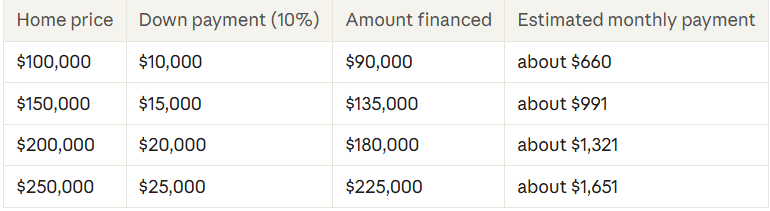
If you’re shopping for homes under $150,000 with owner financing in Memphis, you can see how a $10,000 or $15,000 down payment can put you in the same range as a typical monthly rent. You can run your own numbers with the cash flow calculator on the seller page.
Is It Worth Putting More Down?
Sometimes yes, sometimes no. Here’s how the down payment changes the monthly payment on a $150,000 home, using the same 8%, 30-year assumptions:
Going from 5% down to 20% down saves roughly $165 a month in this example. That’s real money over time. But it also means you need $22,500 more in cash on day one. If emptying your savings leaves you with no cushion for a broken water heater, a smaller down payment and a slightly higher monthly payment can be the smarter call.
A good rule of thumb: put down as much as you comfortably can while keeping an emergency fund of at least a couple of months of expenses.
What Decides How Much Down Payment You Need?
Because the seller sets the rules, several things influence the number:
- The price of the home. A $70,000 house and a $350,000 house don’t carry the same risk, so the expectations differ.
- The seller’s situation. A seller who owns the home free and clear has more flexibility than one who still has a mortgage and needs cash.
- Your income and payment history. Some sellers weigh credit lightly and care more about steady income. Many still ask about both. A stronger profile can earn a smaller down payment.
- The condition of the property. A home that needs repairs may come with a lower price and a different down payment than a move-in-ready one.
- The interest rate and term. A seller may accept less down if the rate is higher or the term is shorter. It’s a trade-off, so ask to see a couple of versions.
- How motivated both sides are. Sellers who want steady monthly income and buyers who want a path to ownership usually find a middle ground.
Can You Buy a Home in Memphis With $10,000 Down?
Often, yes, especially on lower-priced homes. Owner financing with $10,000 down in Memphis tends to work best on homes in the $70,000 to $130,000 range, where $10,000 is close to 10%. On a $250,000 home, $10,000 is only 4%, so a seller may ask for more or charge a higher rate.
Some sellers also accept $20,000 down on mid-priced homes. Picture a family looking at a three-bedroom house listed around $180,000. A $20,000 down payment is about 11%, which many sellers consider a solid commitment. Those families are often renting at a similar monthly cost already, which is why this route appeals to them.
The point is not to chase the lowest possible number. It’s to find a price, down payment, and monthly payment you can keep up with for years.
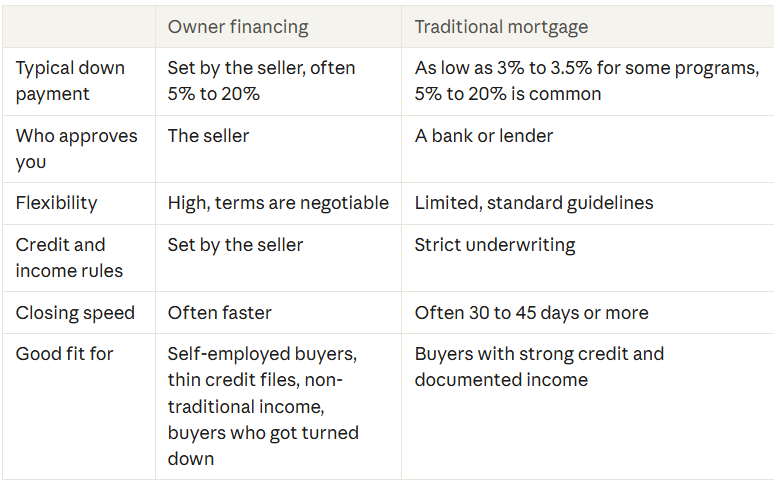
Owner Financing vs Traditional Mortgage: How Do the Down Payments Compare?
Bank loans can actually have lower minimums on paper. The catch is qualifying for them.
What Else Should You Budget For Besides the Down Payment?
The down payment isn’t the only cost. Plan for these as well:
- Closing costs. Title work, recording fees, and attorney or closing agent fees.
- Earnest money. A small deposit that usually goes toward your down payment.
- Home inspection. Usually a few hundred dollars and worth every cent.
- Homeowners insurance. Required by most sellers, and often due at closing.
- Property taxes. Paid yearly or collected monthly depending on your agreement.
- Repairs and moving costs. Set aside a cushion, especially for an older home.
Is Owner Financing Legal in Tennessee?
Yes. Seller financing is legal in Tennessee, and it’s a long-standing way to sell property. That said, federal and state rules can apply depending on how the deal is set up and how many owner-financed sales a seller makes. This is why a clear owner financing contract in Tennessee matters. The paperwork usually includes a promissory note, a deed of trust or land contract, and a payment schedule. Have a Tennessee real estate attorney or title company review everything before you sign. This article is general information, not legal or financial advice.
How to Figure Out Your Down Payment in 5 Steps
- Count your cash. Add up savings you can use without touching your emergency fund.
- Set a monthly ceiling. Many buyers aim for a total housing payment around 30% of their take-home income or less, though your own numbers matter more than any rule.
- Run the math. Try a few down payments and prices in a calculator, like the examples above.
- Browse real listings. Look at houses for sale with owner financing in Memphis and note which ones fit your range.
- Ask for options. Request two or three versions of the terms with different down payments and rates, then choose the one that fits your budget.
Common Mistakes to Avoid
- Spending every dollar on the down payment and having nothing left for repairs.
- Agreeing to a payment you can only afford if everything goes perfectly.
- Skipping the inspection because the price looks good.
- Not asking what happens if you miss a payment, including grace periods and late fees.
- Signing without a title search or attorney review.
- Assuming the first offer is the only offer. Terms are negotiable.
Frequently Asked Questions
How much down payment do I need for owner financing in Memphis?
Most owner-financed homes in Memphis require 5% to 20% down, and 10% is a common starting point. Some listings advertise $10,000 or $20,000 down. The seller decides, so the amount can often be negotiated.
Can I buy a house in Memphis with $10,000 down?
Yes, in many cases, especially on homes priced around $70,000 to $130,000. On higher-priced homes, a seller may ask for more or adjust the interest rate.
Is the down payment refundable?
Generally not once the deal closes. Earnest money may be refundable under conditions written in your contract, such as a failed inspection. Read the agreement carefully and ask a Tennessee attorney if you’re unsure.
Do I need a bank to buy a home with owner financing?
No. In owner financing, the seller provides the financing, so you don’t need a bank loan. That’s what makes it a common option for no-bank home buying in Memphis.
Does a bigger down payment lower my monthly payment?
Yes. A larger down payment reduces the amount you finance, so your monthly payment and total interest both go down. On a $150,000 home, going from 5% to 20% down can lower the payment by about $165 a month at an 8% rate.
Are interest rates higher with owner financing?
Often they are somewhat higher than bank rates, because the seller takes on risk the bank wouldn’t. The rate is negotiable, and a larger down payment can sometimes help you get a better one.
Do I need good credit for owner financing?
It depends on the seller. Some sellers weigh credit lightly and focus on income, down payment, and payment history. Others do look closely at credit. Being upfront and organized helps either way.
Can I use owner financing if I’m self-employed?
Yes. Many self-employed buyers choose owner financing because banks often want two years of tax returns showing high income. A seller can look at your bank statements and overall stability instead.
Leave a Reply